Influence of Molybdenum (Mo) Doping on the Structural, Optical, and Electrical Characteristics of Zirconium Oxide (ZrO2) Nanostructures for Optoelectronics and Photovoltaic Applications
Samuel Oghenemega Shaka
Department of Science Laboratory Technology, Delta State University, Abraka, Nigeria.
Cletus Olisenekwu *
Department of Science Laboratory Technology, Delta State University, Abraka, Nigeria.
Ogemuno Ufuoma Mayman
Department of Science Laboratory Technology, Federal University of Petroleum Resources, Effurun, Nigeria.
Akpevweoghene Obunegbe
Department of Geophysical Science Laboratory Technology, University of Benin, Edo State, Nigeria.
Ugochukwu Success Arinze
Department of Science Laboratory Technology, Delta State University, Abraka, Nigeria.
Timothy Victor
Department of Science Laboratory Technology, Delta State University, Abraka, Nigeria.
*Author to whom correspondence should be addressed.
Abstract
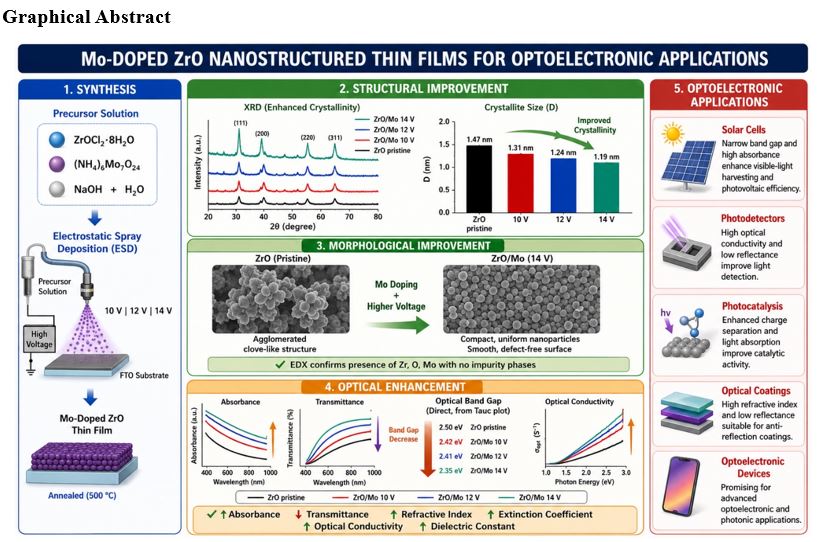
This study investigated the influence of molybdenum (Mo) doping on the structural, optical, morphological, and electrical properties of zirconium oxide (ZrO2) nanostructured thin films for optoelectronic and photovoltaic applications. Mo-doped ZrO2 thin films were deposited on fluorine-doped tin oxide (FTO) substrates using the Electrostatic Spray Deposition (ESD) technique. The precursor solution was prepared from zirconium (IV) oxychloride octahydrate (ZrOCl₂·8H₂O), ammonium molybdate ((NH₄)₆Mo₇O₂₄·4H₂O), sodium hydroxide (NaOH), and distilled water. Deposition voltages of 10, 12, and 14 V were used for the doped films, while pristine ZrO2 served as the control. Increasing the deposition voltage enhanced droplet atomization, charge density, and spray stability, resulting in improved substrate wetting and more uniform film formation. X-ray diffraction (XRD) analysis showed that pristine ZrO2 exhibited broad diffraction peaks indicative of low crystallinity, whereas Mo doping enhanced crystallinity through sharper and more intense peaks. The crystallite size decreased from 1.47 nm for pristine ZrO2 to 1.19 nm for the film deposited at 14 V, while the dislocation density increased from 1.36 lines/m² to 2.29 lines/m². SEM images revealed a transformation from agglomerated clove-like structures to smoother, compact, and homogeneous nanostructures, and EDX confirmed successful Mo incorporation without significant impurities. Optical studies showed increased absorbance and reduced transmittance with Mo doping. The optical band gap decreased from 2.50 eV for pristine ZrO2 to 2.42 eV, 2.41 eV, and 2.35 eV for films deposited at 10 V, 12 V, and 14 V, respectively, indicating enhanced visible-light absorption. Refractive index, extinction coefficient, optical conductivity, and dielectric constants also increased. Film thickness increased from 105.15 nm to 129.01 nm, while resistivity rose slightly from 5.83 × 10⁻⁷ Ω·m to 6.39 × 10⁻⁷ Ω·m and conductivity decreased from 1.72 × 10⁻¹⁰ S/m to 1.56 × 10⁻¹⁰ S/m. These findings indicate the potential of ZrO2/Mo thin films for solar cells, photodetectors, photocatalysis, optical coatings, and other optoelectronic applications.
Keywords: Optoelectronics, optical conductivity, electrical conductivity, zirconium, molybdenum, photovoltaic, zirconia, thin films, doping, band gap